
Prenuptial and postnuptial agreements establish clear rules for managing assets and debts between spouses. At The Family Law Group, we guide you through the process of creating these agreements so you can address financial matters with transparency and confidence. An Ohio prenuptial agreement is drafted before marriage to outline how property, debts, and potential spousal support will be handled. A postnuptial agreement in Ohio serves a similar purpose but is created after you are married, often reflecting changes in income, assets, or financial responsibilities.
Both types of agreements follow Ohio laws, which set standards for fairness, full financial disclosure, and voluntary consent. Working with experienced postnup and prenup lawyers near you makes sure that the agreements meet legal requirements and clearly reflect your intentions. Whether you are planning for marriage or reviewing your financial arrangements later, these agreements provide a structured way to define expectations and protect your interests.
Understanding Ohio Prenuptial Laws
Ohio prenuptial agreements carry specific rules that determine how they are handled and enforced by the courts. These rules guide you in creating an agreement that reflects your intentions and addresses financial matters clearly.
Legal Requirements for Prenups in Ohio
Ohio prenups are valid only if specific legal requirements are met.
- Full financial disclosure: Both you and your partner must provide a complete and accurate account of your assets, debts, and income. Without full disclosure, the agreement may be challenged in court.
- Written and signed agreement: Oral agreements are not recognized under Ohio law. You must put the terms in writing, and both parties need to sign the document to give it legal effect.
- Voluntary consent: The agreement must be signed freely, without any pressure, threats, or manipulation. Courts will review whether each party had the opportunity to review the terms independently.
Following these guidelines increases the likelihood that your agreement will be respected under Ohio prenuptial laws.
Enforceability of Prenups
Prenuptial agreements are enforceable when courts determine they are fair and comply with Ohio law.
There are situations where a prenup could be invalidated, including:
- One party did not provide full financial information.
- The agreement was signed under duress or coercion.
- The terms are extremely one-sided or favor one party unfairly.
Working with experienced attorneys can help you address potential issues before they arise and create a stronger agreement that reflects both parties’ intentions.
Topics Addressed in Prenuptial Agreements
Prenups outline financial responsibilities and asset division. They allow you and your partner to define how property, debts, and potential spousal support will be handled. Common topics include:
- Asset division: Allocation of property, savings, and investments held individually before marriage.
- Debt allocation: Responsibilities for any current or future debts.
- Spousal support: Agreements may include provisions, though courts retain ultimate authority in setting support.
| Provision Type | Enforceable in Ohio | May Be Challenged |
| Asset division | Yes | Unreasonable allocation |
| Debt allocation | Yes | Concealed debts |
| Spousal support terms | Yes (court-approved) | Excessively one-sided agreements |
At The Family Law Group, we guide couples in Cleveland and Northeast Ohio through the process of creating prenuptial agreements that align with Ohio law. Our attorneys help you organize financial information, draft clear terms, and address any concerns so the agreement reflects your intentions and stands up to legal review.
Postnuptial Agreements in Ohio
Married couples sometimes reach a point where financial matters need to be clarified or updated. A postnuptial agreement allows both partners to establish clear financial terms that reflect their current situation and future expectations.
What is a Postnuptial Agreement?
A postnuptial agreement clarifies financial terms after marriage. It sets out how you and your spouse will handle assets, debts, and spousal support if circumstances change or the marriage ends. Unlike a prenup, this agreement reflects your current financial situation rather than what was anticipated before marriage.
A postnuptial agreement in Ohio must follow the same legal requirements as a prenuptial agreement. Both spouses need to provide full disclosure of their finances and must voluntarily agree to the terms. Courts in Ohio examine these agreements to confirm that both parties signed without pressure and with complete knowledge of each other’s financial position.
Key Differences Between Prenups and Postnups
Timing distinguishes prenups from postnuptial agreements. Prenuptial agreements are signed before marriage, outlining how finances will be handled from the start. Postnuptial agreements are executed after you are married and often reflect changes in income, property, or responsibilities.
Courts review postnuptial agreements carefully to confirm that both parties participated willingly and that terms are fair. While both types of agreements protect financial interests, their timing and context differ, and each serves a distinct role based on your marital status.
Circumstances for Considering a Postnuptial Agreement
Postnuptial agreements are often created after financial circumstances change. You may consider drafting one if you experience a substantial increase in income, inherit property, or acquire business assets. These agreements let you clearly outline responsibilities for assets and debts, which can reduce disagreements in the future.
Other common scenarios include purchasing a home, starting a business, or receiving unexpected inheritance. By putting the arrangement in writing, you and your spouse have a clear record of how financial matters will be handled.
The attorneys at The Family Law Group can guide you through creating a postnuptial agreement tailored to your needs, ensuring that the process is straightforward and respects both parties’ interests.
Working With Postnup and Prenup Lawyers Near You
When you consider creating a prenuptial or postnuptial agreement, having legal guidance can make the process clearer and more manageable. Working with a knowledgeable attorney helps you address details that you might not notice on your own.
How Legal Guidance Supports Agreement Enforcement
Experienced attorneys guide agreements to comply with Ohio law. They can:
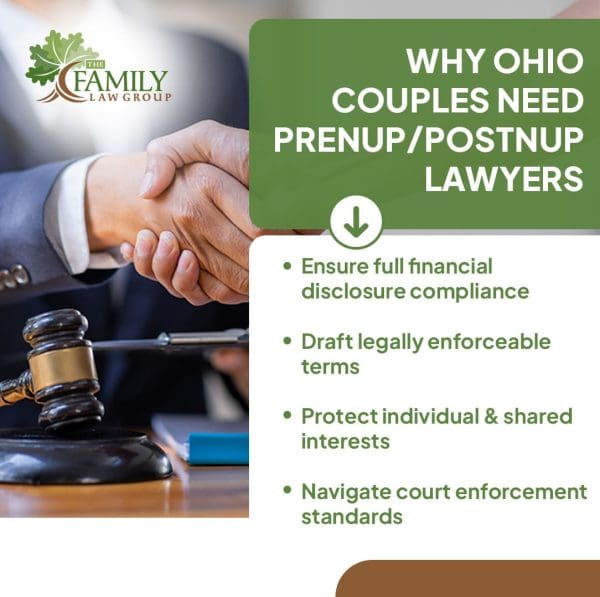
- Draft agreements that follow Ohio laws so the terms are valid and recognized by the courts.
- Advise on financial disclosure by reviewing assets, debts, and income to confirm that both parties present accurate information.
- Reduce the risk of invalidation or court disputes by checking for fairness and voluntary consent, helping the agreement hold up if challenged.
Steps to Drafting a Prenup or Postnup in Cleveland, Ohio
Creating a legally valid agreement involves clear steps:
- Consultation: Meet with an attorney to discuss your financial goals and personal circumstances.
- Financial disclosure: List all assets, debts, and income openly to provide a complete picture.
- Drafting and review: Work with the attorney to prepare the agreement and review each section carefully.
- Signing and notarization: Sign voluntarily, often in the presence of a notary, to strengthen legal recognition.
Working with postnup and prenup lawyers near you helps you create an agreement that is clear, thorough, and aligns with Ohio law. The Family Law Group supports clients in Cleveland and Northeast Ohio through every step of this process, helping you address financial matters confidently and professionally.
Common Questions About Ohio Prenups and Postnups
Many couples have similar questions about prenuptial and postnuptial agreements. We address the most common concerns to give you a clearer picture of how these legal documents function under Ohio law.
Are prenups enforceable in Ohio?
Yes, if both parties voluntarily consent and fully disclose finances. You have the ability to draft a prenuptial agreement that specifies asset division, debt responsibility, and spousal support, but the agreement will only hold up in court if both partners participate willingly and share accurate financial information. Courts examine whether both parties entered the agreement without pressure and with complete knowledge of each other’s financial situation.
Can postnuptial agreements override a prenup?
Occasionally, but courts carefully review fairness and voluntary participation. If you already have a prenup, you may update or replace certain terms with a postnuptial agreement. Ohio courts will review the new agreement to make sure both partners signed it freely and that the provisions are reasonable.
How long does it take to create an agreement?
Usually a few weeks, depending on financial complexity. You can often complete the process in a short period, especially if your assets and debts are straightforward. More complex situations, such as business ownership or multiple properties, may take additional time for proper disclosure and drafting.

Schedule a Consultation With The Family Law Group
The Family Law Group provides professional guidance for prenups and postnups in Cleveland and Northeast Ohio. Our attorneys work directly with you to review your financial situation, answer your questions, and guide the process step by step.
Contact our attorneys to:
- Protect your assets and financial interests – We help you define how property and debts are handled, reducing uncertainty and potential conflicts.
- Draft agreements compliant with Ohio laws – Every agreement is prepared to meet state requirements for disclosure, fairness, and voluntary participation.
- Receive personalized legal guidance – You’ll work with a legal team that focuses on your unique circumstances and goals.
Contact Us Today
Take the next step in protecting your financial interests by consulting with The Family Law Group. Whether you are planning a prenuptial agreement before marriage or considering a postnuptial agreement in Ohio, our experienced attorneys are ready to guide you through the process with personalized legal support.
Call us today at (216) 239-5050 to schedule your consultation. You can also visit our Contact Page to submit your inquiry online. Partnering with us gives you professional guidance and clarity, helping you define financial arrangements that reflect your goals and circumstances.
Schedule a Consultation
You can get in touch with us through phone or our contact form. However, contacting us does not automatically create an attorney-client relationship. For these reasons, please refrain from sending any confidential information to us before we establish a legal attorney-client relationship.
Are you in the Cleveland and Northeast Ohio area? We are here to answer all your questions, schedule your initial consultation today!
 SCHEDULE A CONSULTATION